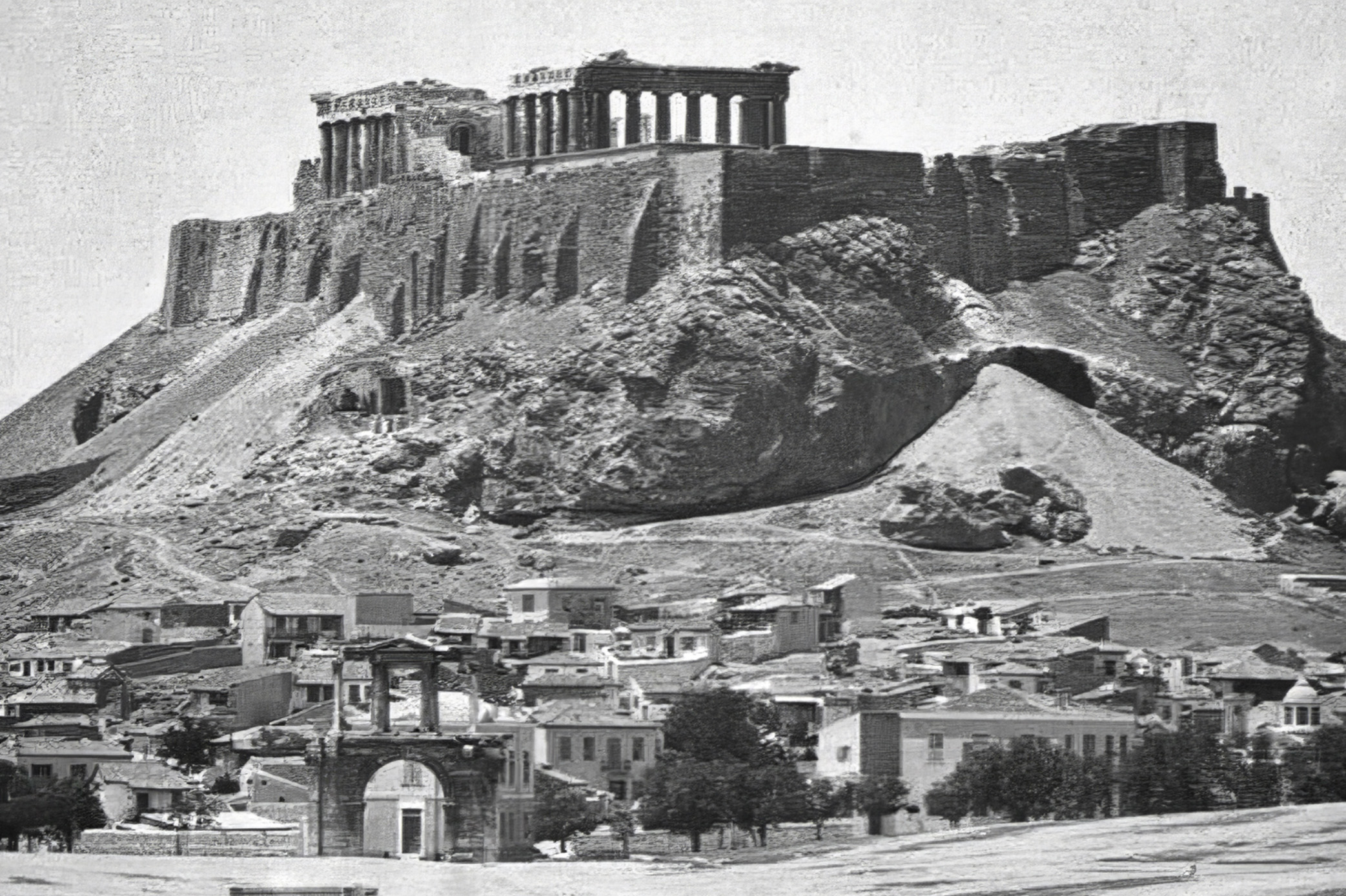
Seminar-workshop (participation by application)
7-8 Februar 2026, 11.00-15.00
Athens University Museum of History, Tholou 5 Plaka, Athens
Organized by:
Academic coordination:
Dr. Elisavet P. Sioumpara Project Manager for the Scattered Architectural Members of the Acropolis, Acropolis Restoration Service, Greek Ministry of Culture, CHS Early Career Fellow in Hellenic Studies 2023-24
Harvard University’s Center for Hellenic Studies in Greece and the Canellopoulos Museum organize the workshop “Reshaping Acropolis: Past with a Future.” CHS Greece, through its annual workshop series, aims to support Hellenic Studies and the broader field of Humanities, and to offer intergenerational, interdisciplinary, lifelong learning opportunities to the public.
In this workshop, we will delve into specific aspects of the Acropolis, the most emblematic archaeological site of our country; so familiar and beloved to us through lived experience, yet never ceasing to surprise us with new information revealed through ongoing work daily on the site, much of which remains largely unknown to the broader public.
The North Wall of the Acropolis was built immediately after the Persian Wars and the destruction of the Sanctuary, with Themistocles himself as the driving force behind the new design. Do the architectural members of the destroyed temples that were reused in its construction convey specific political messages, or perhaps less so than we would like to believe today? Does the sanctuary of Athena constitute the most sacred place for the Athenians solely, or did it clearly have political functions and dimensions from the very moment of its foundation? And if so, what are these? How could each Athenian enter this quintessentially public space and engage with it? These are some of the questions that will concern us, before we conclude with a discussion on how we would like to experience the Acropolis from now on, in the city where we live, and under today’s conditions of high visitation.
Thematic areas – Workshop structure
The approach to the topic will be organized around the following thematic axes:
Day 1
- The Acropolis from the North. The reception of the Sanctuary and the Themistoclean Wall of the Acropolis immediately after the Persian Wars
- The sanctuary of Athena on the Acropolis as a political space in Antiquity
Day 2
- I was there too! Private individuals on the Acropolis from antiquity to today
- And now what? 17,000 eyes and feet, doubled, on the Acropolis every day.
The coordinator will present the above themes, emphasizing, on the one hand, new research findings on the Acropolis and, on the other, how these shed light on the site’s multidimensional functions, practical, aesthetic, and symbolic, through time. When does the reuse of materials result in manipulative political propaganda, and when does it not, when does a sanctuary serve key political functions at the heart of its city, when do the priests who control the sacred precinct allow private individuals to enter and occupy part of the sacred space, and under what conditions? Participants will actively engage in the dialogue that will develop around these topics, as well as in an effort to partially juxtapose past phenomena with those of the present, to the extent possible.
The multilayered uses of the Acropolis, the quintessential sacred and public space of ancient Athens, rising both literally and metaphorically at the center of the city, then and now, forming its core, prompt us to renegotiate the terms under which we would ultimately like to experience, observe, and behold our own Acropolis today, both individually and collectively. Finally, a spiral-shaped round of discussion will follow with participants about the site’s contemporary use.
Objectives
Participants in the workshop are expected to:
- gain a better understanding of specific fragments/aspects of their own city,
- delve deeper into issues related to the operation and management of ancient sites,
- learn what is happening at the Acropolis today,
- clarify for themselves how they would like to experience the Acropolis from now on,
- examine what is feasible and what is not feasible at the Acropolis today.
Applications and Participation
Interested applicants are invited to submit an individual online application to participate in the workshop. In the application, they must complete:
- their personal details and status (e.g., studies or profession),
- a brief description (no longer than one paragraph) outlining their expectations, motivation for participating, and/or any issues or questions they have in relation to the topic,
- a short chronological CV, not exceeding 150 words.
The number of places will be limited. Participants will be selected by the workshop coordinator based on their CV and the information provided in the online application. No prior knowledge of the subject is required. Participation in the workshop is free of charge.
Submission of Applications
Application | Reshaping Acropolis: Past with a Future – Forms and Applications
Open to: Everyone (limited number of places)
Application period: 11 December 2025 – 11 January 2026
Activity coordination: Matina Gogka (CHS)
All applicants will be notified by 23 January 2026 via email regarding the status of their application. Selected participants will need to confirm their participation by email and will be informed about their participation as well as any relevant forms they will be required to submit.
CHS will provide participants with a letter of appreciation certifying their participation in the workshop.
For clarifications regarding the workshop and the application process, you may contact the Center for Hellenic Studies daily (10:00 a.m.–5:00 p.m.) at +30 2752047030, ext.: 1.